A Tragic Spray of Bullets
At a gun show in Westfield, Massachusetts, organized by a former police chief, Chistopher Bizilj (age 8) lost his life. Among the guns that two men brought to the show was a small Uzi submachine gun. They handed the gun to Bizilj, who started to fire the gun, lost control, and accidentally and fatally shot himself.
Now, the event organizer and two weapons providers are on trial for involuntary manslaughter in the boy's death. Originally scheduled for trial this month, the case has been continued until December.
The three defendants will certainly attempt to defend their actions as inherently safe and reasonable. Their defense will be that this was a horrible, unforeseeable accident. Such a defense might have difficulty holding sway even among a group of philosophers and legal scholars, sitting around a conference table. The odds are even longer in an emotionally charged courtroom.
No Such Thing as an Accident?
One major obstacle facing the defense is "hindsight bias," a term that I have discussed multiple times in other Jury Box posts. In short, hindsight bias refers to the tendency of people to perceive a highly unlikely, or freakish, event as having been more likely than it was, just because it happened. For instance, if someone gets struck by lightening in your home town, you might come to believe that this is a much more common occurrence than it actually is.
Hindsight Bias tends to lead jurors down a path of irrational inferences. Because people don't like the idea of life being beyond their own abilities to control it, they tend also to overestimate the likelihood that someone is actually responsible for a freakish occurrence, especially a dangerous one. The crazier and more improbable the circumstances, the more uncomfortable it makes people feel. They feel increasingly compelled to assign blame to someone. This results in a rather perverse relationship between the randomness of an event and the need of people to hold someone responsible for it. (This is actually the nexus of hindsight bias and terror management theory.)
One of the greatest fears facing any parent is the prospect of losing a child to senseless violence. A juror will internally resist seeing this event as an accident because doing so only highlights the vulnerability of their own children. While the defense might hope for some support among jurors who are gun advocates, such people are likely to try to differentiate themselves from the defendants. "Oh, a responsible gun owner would never handle a weapon that way. I always lock my guns when children are around. I'd never hand a loaded weapon to a small boy. That's just what the left-wing loonies think we do all the time."
From Blame Avoidance to Blame Shifting
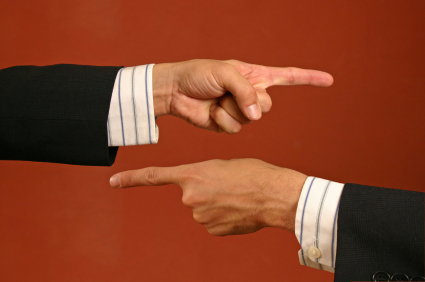
In light of the issues identified above, it will be very difficult for the defendants in this case to convince a jury that the boy's death was simply the result of a tragic accident. The desire to hold someone accountable will just be too strong. The defendants would do well to try to shift the blame elsewhere. This strategy is not without risk and might engender some resentment among jurors. But it also just might work.
The major difficulty here might be finding someone else to point the finger at. One obvious possibility is the boy's parents. What were they doing taking an 8-year old to a gun show? Did his father really let him just take the gun? Had they ever taught him about gun safety? The danger of such a strategy, however, is self-evident. Because the parents have just suffered such a terrible loss, the defendants would face major resentment for "blaming the victim."
Perhaps the event organizer can point to regulations that precluded him from keeping children out of the event. Perhaps the suppliers can point to manufacturer guidelines that identify the gun as suitable for use by youngsters. The gun suppliers have already claimed that Fleury, the event organizer, incorrectly assured them that it was legal in Massachusetts for a minor to fire an Uzi. In addition, the gun club that hosted the event has already settled its criminal charges. This provides an opportunity to assign blame to a party that won't be in the courtroom to defend itself.
Over all, I believe that the defendants in this case will have a very difficult time overcoming the effects of hindsight bias. I fully expect plea deals to be struck before the jury ever gets charged.
Recent Jury Box Blog Entries
Subscribe to The Jury Box Blog
Showing posts with label hindsight bias. Show all posts
Monday, November 15, 2010
Thursday, January 28, 2010
Defense must play blame game in Rebecca Riley murder trial
The tragedy
Rebecca Riley, age 4, died in the throes of pneumonia, while very heavily medicated on Depakote and Clonidine, intended to treat ADHD and bipolar disorder. Her parents, Carolyn and Michael, are on trial for Rebecca's murder (Read about the trial here). According to prosecutors, Carolyn and Michael routinely lied to doctors in an effort to get all their children prescribed strong drugs, eventually finding a Boston psychiatrist willing to believe them and hand out ever-stronger doses. Prosecutors claim that the Rileys cared only about making their children easy to manage, regardless of any adverse health consequences, and collecting federal disability benefits. Eventually, after being given extremely high dosages of these powerful drugs, even by adult patient standards, Rebecca died in her parents' home.
When a tragedy like this strikes, it is quite natural for ordinary people to want to assign blame. Someone must have been responsible and that person should be held accountable. Why is there such a palpable need to assign blame? It stems from several reinforcing psychological phenomena.
The human need for answers and accountability
The first is a natural aversion to reminders of one's own mortality. We don't like to feel vulnerable. Therefore, when bad things -- deadly things -- happen to others, our brains automatically generate reasons why such threats aren't dangerous to us. A standard response is to generate distinctions between the victim's circumstances and our own. Some distinctions are circumstantial, while others are directed at choices made by the victim or some other responsible party.
A second psychological response to such a tragedy is to shrink back from the randomness of a bad event. We don't like to think that we are not in control of our own lives. We like to think that our own actions and choices will insure our own well-being. Therefore, people tend to overestimate the control that someone else could have exercised over a difficult situation. This is because any bystander would like to believe that, had she been in the same situation, she would have been able to stop the tragedy from occurring.
Finally, as I have written about on a number of occasions, hindsight bias is always at play when rare events take place. Ordinary people have a great deal of trouble processing the true chance of very unlikely events. The numbers just get too small for the brain to easily process. (What does a 1-in-500,000 chance really look like?). Also, the cognitive availability of an event (after all, the event is the focus of the trial) makes it seem more likely to have occurred. This tendency to overestimate the likelihood of an event also results in people overestimating the events predictability and preventability. An odd second-order effect is that the more peculiar the circumstances, the more likely people are to assume that a tragedy could have been averted.
Jurors are not experts in risk assessment. They typically don't have degrees in statistics or bioinformatics. They are ordinary folks, tasked with processing some very foreign circumstances. As such, they will be subject to the kinds of cognitive tendencies outlined above. The Rebecca Riley death is a very strange story. The loss of a young child is every parent's worst nightmare. The world of pediatric psychiatry seems very alien to all of the jurors. All of these factors will combine to make the jurors very eager to find someone to blame for this horrible tragedy. Once they assign blame, they can go back to believing that such a thing could never happen to them.
What should the defense team do?
This is the environment in which Carolyn and Michael Riley are being tried. One defense strategy might be to portray this death to the jury as an unfortunate accident. For the reasons I outline above, I think this will be an extremely tough sell. A better strategy would be to try to deflect blame onto others. Let the jurors have their culprit, but try to convince at least some of them that the culprit is someone other than the defendant.
The defense team took a sensible first step in this direction by requesting separate trials for the two parents. This allows each to deflect responsibility to the other. The key for Carolyn's legal team is to get at least some on the jury to assign more responsibility to her husband than to her. Frankly, based on what we have heard so far, such a tactic would seem more promising for Michael's defense than for Carolyn's.
The second likely candidate for deflected blame is the psychiatrist who prescribed the medication. Dr. Kayoko Kufuji has now testified in Carolyn's trial. While she came across as detached and somewhat clueless, which points to her own negligence, the prosecution did a very good job of showing how Dr. Kufuji relied very heavily on Carolyn Riley's own characterizations of her children, when making her diagnoses. As such, Kufuji's failures seem largely the result of Carolyn Riley's dishonesty and manipulation.
The third candidate for deflected blame, and the one I think is most likely to garner some sympathy with jurors, is Carolyn Riley's own mental state. The prosecutor is trying to paint a picture of a calculating, manipulative mother who happily endangered her children to keep them docile and to collect federal disability checks. The defense might just gain some traction by telling the jury that she was mentally unbalanced. There are official conditions, like Munchausen-by-proxy, where parents imagine or invent illnesses in their children to fulfill a pathological need for attention. Alternatively, the defense could attribute her extreme behavior to the abusive treatment by her husband. Michael Riley has been banned from a prior residence due to violent behavior and Carolyn Riley once took out a restraining order against her husband, ostensibly to protect her children. Under such a scenario, the defense can contend that the system let Carolyn down, enabling behavior that was not only self-destructive, but also endangered the Riley children.
Will it work?
Jurors are generally skeptical of victimization arguments like the one I outline above, but it seems the best strategy in a case like this. There is a documented history of spousal abuse. Many authority figures who interacted with Carolyn and her children failed to take official action. Remember that only one juror needs to be convinced that Carolyn Riley wasn't completely responsible for her own actions to avoid a murder conviction.
The defense strategy needs to be focused on getting Carolyn's sanity into the discussion in the jury room. They need to open the door for those who might be inclined to take pity on her. I rather doubt that the jury will initially be unanimous in its evaluation of her culpability. Arguments will be heated. Tears will be shed. Playing up the defendant's mental instability might not keep her out of jail, but I could see a conviction on a lesser included offense, such as involuntary manslaughter. Given what has transpired in court so far, that would probably be considered a victory for the defense.
Rebecca Riley, age 4, died in the throes of pneumonia, while very heavily medicated on Depakote and Clonidine, intended to treat ADHD and bipolar disorder. Her parents, Carolyn and Michael, are on trial for Rebecca's murder (Read about the trial here). According to prosecutors, Carolyn and Michael routinely lied to doctors in an effort to get all their children prescribed strong drugs, eventually finding a Boston psychiatrist willing to believe them and hand out ever-stronger doses. Prosecutors claim that the Rileys cared only about making their children easy to manage, regardless of any adverse health consequences, and collecting federal disability benefits. Eventually, after being given extremely high dosages of these powerful drugs, even by adult patient standards, Rebecca died in her parents' home.
When a tragedy like this strikes, it is quite natural for ordinary people to want to assign blame. Someone must have been responsible and that person should be held accountable. Why is there such a palpable need to assign blame? It stems from several reinforcing psychological phenomena.
The human need for answers and accountability
The first is a natural aversion to reminders of one's own mortality. We don't like to feel vulnerable. Therefore, when bad things -- deadly things -- happen to others, our brains automatically generate reasons why such threats aren't dangerous to us. A standard response is to generate distinctions between the victim's circumstances and our own. Some distinctions are circumstantial, while others are directed at choices made by the victim or some other responsible party.
A second psychological response to such a tragedy is to shrink back from the randomness of a bad event. We don't like to think that we are not in control of our own lives. We like to think that our own actions and choices will insure our own well-being. Therefore, people tend to overestimate the control that someone else could have exercised over a difficult situation. This is because any bystander would like to believe that, had she been in the same situation, she would have been able to stop the tragedy from occurring.
Finally, as I have written about on a number of occasions, hindsight bias is always at play when rare events take place. Ordinary people have a great deal of trouble processing the true chance of very unlikely events. The numbers just get too small for the brain to easily process. (What does a 1-in-500,000 chance really look like?). Also, the cognitive availability of an event (after all, the event is the focus of the trial) makes it seem more likely to have occurred. This tendency to overestimate the likelihood of an event also results in people overestimating the events predictability and preventability. An odd second-order effect is that the more peculiar the circumstances, the more likely people are to assume that a tragedy could have been averted.
Jurors are not experts in risk assessment. They typically don't have degrees in statistics or bioinformatics. They are ordinary folks, tasked with processing some very foreign circumstances. As such, they will be subject to the kinds of cognitive tendencies outlined above. The Rebecca Riley death is a very strange story. The loss of a young child is every parent's worst nightmare. The world of pediatric psychiatry seems very alien to all of the jurors. All of these factors will combine to make the jurors very eager to find someone to blame for this horrible tragedy. Once they assign blame, they can go back to believing that such a thing could never happen to them.
What should the defense team do?
This is the environment in which Carolyn and Michael Riley are being tried. One defense strategy might be to portray this death to the jury as an unfortunate accident. For the reasons I outline above, I think this will be an extremely tough sell. A better strategy would be to try to deflect blame onto others. Let the jurors have their culprit, but try to convince at least some of them that the culprit is someone other than the defendant.
The defense team took a sensible first step in this direction by requesting separate trials for the two parents. This allows each to deflect responsibility to the other. The key for Carolyn's legal team is to get at least some on the jury to assign more responsibility to her husband than to her. Frankly, based on what we have heard so far, such a tactic would seem more promising for Michael's defense than for Carolyn's.
The second likely candidate for deflected blame is the psychiatrist who prescribed the medication. Dr. Kayoko Kufuji has now testified in Carolyn's trial. While she came across as detached and somewhat clueless, which points to her own negligence, the prosecution did a very good job of showing how Dr. Kufuji relied very heavily on Carolyn Riley's own characterizations of her children, when making her diagnoses. As such, Kufuji's failures seem largely the result of Carolyn Riley's dishonesty and manipulation.
The third candidate for deflected blame, and the one I think is most likely to garner some sympathy with jurors, is Carolyn Riley's own mental state. The prosecutor is trying to paint a picture of a calculating, manipulative mother who happily endangered her children to keep them docile and to collect federal disability checks. The defense might just gain some traction by telling the jury that she was mentally unbalanced. There are official conditions, like Munchausen-by-proxy, where parents imagine or invent illnesses in their children to fulfill a pathological need for attention. Alternatively, the defense could attribute her extreme behavior to the abusive treatment by her husband. Michael Riley has been banned from a prior residence due to violent behavior and Carolyn Riley once took out a restraining order against her husband, ostensibly to protect her children. Under such a scenario, the defense can contend that the system let Carolyn down, enabling behavior that was not only self-destructive, but also endangered the Riley children.
Will it work?
Jurors are generally skeptical of victimization arguments like the one I outline above, but it seems the best strategy in a case like this. There is a documented history of spousal abuse. Many authority figures who interacted with Carolyn and her children failed to take official action. Remember that only one juror needs to be convinced that Carolyn Riley wasn't completely responsible for her own actions to avoid a murder conviction.
The defense strategy needs to be focused on getting Carolyn's sanity into the discussion in the jury room. They need to open the door for those who might be inclined to take pity on her. I rather doubt that the jury will initially be unanimous in its evaluation of her culpability. Arguments will be heated. Tears will be shed. Playing up the defendant's mental instability might not keep her out of jail, but I could see a conviction on a lesser included offense, such as involuntary manslaughter. Given what has transpired in court so far, that would probably be considered a victory for the defense.
Labels:
ADHD,
bipolar disorder,
blame game,
carolyn riley,
hindsight bias,
juries,
jury trials,
murder,
rebecca riley
Friday, October 02, 2009
Avoiding the Black Swan Effect at trial
Nicholas Nassim Taleb's book, The Black Swan: The Impact of the Highly Improbable, introduced a wide lay audience to the the "black swan effect," whereby people tend to overgeneralize based upon extremely rare, but impactful events. More generally, in psychology, this is referred to hindsight bias. The basic idea is that highly improbable events tend to get noticed. They stick in the brain and are easily accessed mentally. As such, people tend to underestimate just how improbable the event was. In addition, most people are really crummy at comprehending either really large or really small numbers. So, for example, an average person can't really distinguish the difference between a one-in-a-million chance and a one-in-ten-million-chance. Both are pretty much "never gonna happen." By contrast, people are pretty good at appreciating the difference between a coin flip and a one-in-twenty chance. Mathematically, the two comparisons are identical. The first event in each pairing is ten times more likely to happen than the second one.
Recently, Taleb has teamed up with Daniel G. Goldstein, and Mark W. Spitznagel to apply the black swan effect to corporate risk management in an article in the Harvard Business Review, enititled, "The Six Mistakes Risk Managers make in Risk Management." The focus of the article is to help managers recognize hindsight bias in their own decision-making. They caution these risk managers not to think they could have predicted these events from the past. Not should they use them to predict the future.
Given how much difficulty even seasoned risk managers have overcoming hindsight bias, it should not be surprising that ordinary people find the problem almost insurmountable. The problem is that many torts are the results of Black Swan events. A very improbable event takes place, adversely impacting someone in a profound way. That person sues and some company finds itself defending a failure to predict and prevent the unforeseeable. So, a risk manager also needs to understand this issue because it profoundly affects her company's performance in court.
I wrote an article on how (poorly) jurors handle issues of statistics and probabilities for The Jury Box, back when it was a newsletter. In addition, I have given several presentations on this topic, some slides for which can be found here. Given the timeliness of the topic (Really, it's timeless), I am reprinting that original article below. I hope you find it instructive.
A jury trial can be Risky Business (Don’t worry – not all issues will make reference to Tom Cruise). In addition to the inherent uncertainty associated with putting your case in the hands of a group of laypersons, a jury trial is complicated by the fact that jurors themselves are notoriously unreliable at evaluating risk. In this issue I focus on how juries handle probabilities, risks and cost-benefit analyses.
If it weren’t for bad luck, I’d have no luck at all
Most litigation involves a dispute over an unlikely event. A patient develops an allergic reaction, brakes fail, a grape rolls down an aisle to precisely the place where a little old lady is about to take her next step. These low-probability events turn into legal questions of foresee-ability, reasonable care and adequate notice, all of which turn, to one degree or another, on just how unlikely the jury believes the event to have been.
One common problem that jurors have evaluating probabilities is known as hindsight bias. When someone learns of a low-probability event having actually occurred, there is a tendency to treat it as if were much more likely than it was. If a juror places greater likelihood on the event, she will believe it to have been more easily anticipated and will assign greater urgency to guarding against it. The result is that defendants are often blamed for not anticipating and preventing truly freak accidents.
An alarming second order effect is that the more bizarre the circumstances, the greater the hindsight bias. This may be because really weird circumstances are more easily remembered and recalled by jurors.
One strategy for overcoming hindsight bias is to argue by analogy to something with which jurors are likely to be familiar. The problem usually confronts defense counsel, so it is also wise to choose an analogy for which jurors might feel some responsibility. For instance, if one argues that an allergic reaction to a medication is as common as an automobile accident caused by a sneezing driver, jurors may conclude that the situation was not very dangerous, given that they never pull over their cars just because they need to sneeze.
All costs with no benefits
The economic theory of reasonable care in tort goes back at least as far as Learned Hand’s opinion in Carroll Towing. A cost-benefit analysis showing that all economically efficient precautions were taken is supposed to be a defense to a charge of negligence. Many industry regulations make such calculations mandatory. One might imagine, then, that jurors would look favorably upon companies who perform cost-benefit analyses. One would be dead wrong. Typically, whatever appreciation that jurors might have for a company thinking hard about safety is overwhelmed by their discomfort in reducing human pain and suffering to a mathematical calculation, especially one involving money.
Several empirical studies have shown that defendants are almost always punished for performing cost-benefit analyses, regardless of how clearly the calculations support the measures taken. Plaintiffs’ attorneys are wise to play up the cold, callous, calculating nature of the defendant’s methods. By contrast, defense counsel has the difficult task of convincing the jury that her client cares about safety without the testimony being reduced to probabilities, statistics and dollar signs. Again, reasoning by analogy is often the best policy, alerting jurors to the many cost-benefit calculations they perform in their every day lives, with a focus on those costly precautions most people choose not to take. For instance, it is clearly safer for children to wear helmets on playgrounds but almost no parent makes her children wear them.
It is also worth noting that companies are actually punished for placing a higher value on human life in their cost-benefit analyses. While this high value might help marginally in avoiding liability, it creates a costly anchor when jurors are calculating damages.
The zero risk fallacy
Many jurors mistakenly believe that it is possible to make products, services and treatments absolutely safe. They conclude that any risk of loss or injury is unacceptable. They have essentially adopted a strict liability standard despite the law to the contrary. Others have simply decided that manufacturers or service providers, rather than consumers, should be responsible for all safety precautions because of perceived wealth or knowledge advantages.
Many jurors are troubled by the idea of bad things happening to innocent people. Some conclude that the world is unfair and that the poor victim is entitled to be compensated for her loss. The only source from which the jury can take money is the defendant, so liability is attached despite conclusions that the defendant did nothing wrong. The inadmissibility of evidence of insurance can exacerbate this problem since jurors often assume that the absence of any mention of insurance means that the plaintiff had none.
Plaintiffs face their own risks
Juror difficulties with risk and probabilities do not always benefit plaintiffs. Plaintiffs who are engaged in risky activities are sometimes entitled to compensation because defendant’s conduct unacceptably increased the risk. Jurors sometimes conclude that risk-takers implicitly assume all responsibility for their well-being. For instance, a juror might think, “Hey, skiing is a dangerous sport. If you get hurt, you have no-one to blame but yourself.” A plaintiff will have trouble convincing such a juror that the ski-binding manufacturer is liable for her injuries.
In most cases, both parties have behaved imperfectly. Some jurors implicitly adopt a contributory negligence rule, whereby any fault by the plaintiff bars compensation. I recommend that counsel make sure that the jury is given a very clear instruction on negligence. Ideally, the jury should be given the instruction in advance of opening arguments (an increasingly common practice, endorsed by the ABA). The idea is to get the jury to focus as quickly as possible on the defendant’s conduct.
I also recommend that plaintiff’s counsel consider a “de-fanging” strategy, whereby the plaintiff owns up to any personal mistakes. This will prevent defense counsel from raising the plaintiff’s failings in a manner that suggests to the jury that they somehow excuse the defendant’s conduct. If the plaintiff conveys confidence in the legitimacy of her claim despite a full appreciation of her own shortcomings, the jury is more likely to do so, as well.
Recently, Taleb has teamed up with Daniel G. Goldstein, and Mark W. Spitznagel to apply the black swan effect to corporate risk management in an article in the Harvard Business Review, enititled, "The Six Mistakes Risk Managers make in Risk Management." The focus of the article is to help managers recognize hindsight bias in their own decision-making. They caution these risk managers not to think they could have predicted these events from the past. Not should they use them to predict the future.
Given how much difficulty even seasoned risk managers have overcoming hindsight bias, it should not be surprising that ordinary people find the problem almost insurmountable. The problem is that many torts are the results of Black Swan events. A very improbable event takes place, adversely impacting someone in a profound way. That person sues and some company finds itself defending a failure to predict and prevent the unforeseeable. So, a risk manager also needs to understand this issue because it profoundly affects her company's performance in court.
I wrote an article on how (poorly) jurors handle issues of statistics and probabilities for The Jury Box, back when it was a newsletter. In addition, I have given several presentations on this topic, some slides for which can be found here. Given the timeliness of the topic (Really, it's timeless), I am reprinting that original article below. I hope you find it instructive.
A jury trial can be Risky Business (Don’t worry – not all issues will make reference to Tom Cruise). In addition to the inherent uncertainty associated with putting your case in the hands of a group of laypersons, a jury trial is complicated by the fact that jurors themselves are notoriously unreliable at evaluating risk. In this issue I focus on how juries handle probabilities, risks and cost-benefit analyses.
If it weren’t for bad luck, I’d have no luck at all
Most litigation involves a dispute over an unlikely event. A patient develops an allergic reaction, brakes fail, a grape rolls down an aisle to precisely the place where a little old lady is about to take her next step. These low-probability events turn into legal questions of foresee-ability, reasonable care and adequate notice, all of which turn, to one degree or another, on just how unlikely the jury believes the event to have been.
One common problem that jurors have evaluating probabilities is known as hindsight bias. When someone learns of a low-probability event having actually occurred, there is a tendency to treat it as if were much more likely than it was. If a juror places greater likelihood on the event, she will believe it to have been more easily anticipated and will assign greater urgency to guarding against it. The result is that defendants are often blamed for not anticipating and preventing truly freak accidents.
An alarming second order effect is that the more bizarre the circumstances, the greater the hindsight bias. This may be because really weird circumstances are more easily remembered and recalled by jurors.
One strategy for overcoming hindsight bias is to argue by analogy to something with which jurors are likely to be familiar. The problem usually confronts defense counsel, so it is also wise to choose an analogy for which jurors might feel some responsibility. For instance, if one argues that an allergic reaction to a medication is as common as an automobile accident caused by a sneezing driver, jurors may conclude that the situation was not very dangerous, given that they never pull over their cars just because they need to sneeze.
All costs with no benefits
The economic theory of reasonable care in tort goes back at least as far as Learned Hand’s opinion in Carroll Towing. A cost-benefit analysis showing that all economically efficient precautions were taken is supposed to be a defense to a charge of negligence. Many industry regulations make such calculations mandatory. One might imagine, then, that jurors would look favorably upon companies who perform cost-benefit analyses. One would be dead wrong. Typically, whatever appreciation that jurors might have for a company thinking hard about safety is overwhelmed by their discomfort in reducing human pain and suffering to a mathematical calculation, especially one involving money.
Several empirical studies have shown that defendants are almost always punished for performing cost-benefit analyses, regardless of how clearly the calculations support the measures taken. Plaintiffs’ attorneys are wise to play up the cold, callous, calculating nature of the defendant’s methods. By contrast, defense counsel has the difficult task of convincing the jury that her client cares about safety without the testimony being reduced to probabilities, statistics and dollar signs. Again, reasoning by analogy is often the best policy, alerting jurors to the many cost-benefit calculations they perform in their every day lives, with a focus on those costly precautions most people choose not to take. For instance, it is clearly safer for children to wear helmets on playgrounds but almost no parent makes her children wear them.
It is also worth noting that companies are actually punished for placing a higher value on human life in their cost-benefit analyses. While this high value might help marginally in avoiding liability, it creates a costly anchor when jurors are calculating damages.
The zero risk fallacy
Many jurors mistakenly believe that it is possible to make products, services and treatments absolutely safe. They conclude that any risk of loss or injury is unacceptable. They have essentially adopted a strict liability standard despite the law to the contrary. Others have simply decided that manufacturers or service providers, rather than consumers, should be responsible for all safety precautions because of perceived wealth or knowledge advantages.
Many jurors are troubled by the idea of bad things happening to innocent people. Some conclude that the world is unfair and that the poor victim is entitled to be compensated for her loss. The only source from which the jury can take money is the defendant, so liability is attached despite conclusions that the defendant did nothing wrong. The inadmissibility of evidence of insurance can exacerbate this problem since jurors often assume that the absence of any mention of insurance means that the plaintiff had none.
Plaintiffs face their own risks
Juror difficulties with risk and probabilities do not always benefit plaintiffs. Plaintiffs who are engaged in risky activities are sometimes entitled to compensation because defendant’s conduct unacceptably increased the risk. Jurors sometimes conclude that risk-takers implicitly assume all responsibility for their well-being. For instance, a juror might think, “Hey, skiing is a dangerous sport. If you get hurt, you have no-one to blame but yourself.” A plaintiff will have trouble convincing such a juror that the ski-binding manufacturer is liable for her injuries.
In most cases, both parties have behaved imperfectly. Some jurors implicitly adopt a contributory negligence rule, whereby any fault by the plaintiff bars compensation. I recommend that counsel make sure that the jury is given a very clear instruction on negligence. Ideally, the jury should be given the instruction in advance of opening arguments (an increasingly common practice, endorsed by the ABA). The idea is to get the jury to focus as quickly as possible on the defendant’s conduct.
I also recommend that plaintiff’s counsel consider a “de-fanging” strategy, whereby the plaintiff owns up to any personal mistakes. This will prevent defense counsel from raising the plaintiff’s failings in a manner that suggests to the jury that they somehow excuse the defendant’s conduct. If the plaintiff conveys confidence in the legitimacy of her claim despite a full appreciation of her own shortcomings, the jury is more likely to do so, as well.
Labels:
black swan,
hindsight bias,
juries,
jury trials,
neglicence,
probabilities,
risk,
risk management
Subscribe to:
Comments (Atom)